
Six Grantees Receive $6M to Scale AI Solutions for Economic Opportunity
Reforming state hiring systems. Streamlining access to financial aid for underserved students. Developing a hub for public agencies to test, learn and scale AI solutions.
These are some of the ways that recipients of the AI for Economic Opportunity Fund are expanding their reach and impact and creating access to opportunity. GitLab Foundation is proud to share that six prior recipients have been awarded a combined $6M in additional funding to expand their impact and reach.
The AI for Economic Opportunity Fund was established to advance income growth and opportunity through innovative uses of AI, furthering GitLab Foundation’s vision of a world where one million more people can afford a better life. Grantees have not only accessed funding, but also resources to support cutting-edge technologies, productivity improvements, and tools with the potential to unlock more than $1 billion in new income for individuals.
To date, the fund has supported 27 organizations across two cohorts.
“Investing in organizations applying AI to improve lives and expand access to economic mobility has been transformative for the workforce development industry,” said Ellie Bertani, CEO of GitLab Foundation. “Seeing six of our grantees earn scaling grants is a testament to their impact — they’re breaking down systemic barriers for people who need it most.”
The six organizations selected to receive scaling grants represent our funding partners’ commitment to support high-potential projects and enable solutions that reach more people. The grantees receiving additional funding are:
Burnes Center for Social Change, Northeastern University — Reforming state hiring systems to remove degree requirements and enable equitable, skills-based hiring practices to reduce disparities in access to high-quality jobs
CampusEvolve — Developing a personalized AI conversational tool that will guide Washington State's low-income students on their pathways through post-secondary credentials to economic mobility
The National Accreditation Commission — Developing a next-generation, student-centric, AI-enabled accreditation information hub (AIHub) that aligns high-demand, short-term programs and micro-credentials with economic development and labor market needs
SaverLife — Boosting financial security for 1099 workers by developing an AI prototype that provides resources to navigate work supports more seamlessly
Scholarship America — Streamlining access to financial aid for underserved students by automating and proactively awarding aid
Social Finance — Developing an AI Learning and Innovation Hub (AI Hub) for public agencies to test, learn, and scale AI solutions impacting economic opportunity
As the nation’s largest scholarship administrator, Scholarship America is tackling a huge problem: the existing scholarship system requires students to spend hours navigating complex applications and those who lack time, access to advising or institutional knowledge are systematically disadvantaged.
"When financial support depends on complex, student-initiated applications, those who need it most are often left behind," said Mike Nylund, president and CEO of Scholarship America. “There are nearly 4 million college students who are parents with higher GPAs than their non-parenting peers, but time poverty and childcare expenses make it difficult to keep up. If we can reach them with assistance before they face a crisis, the lifetime ROI is astonishing.”
Their AI-powered platform creates a powerful multiplier effect, helping students discover 500 additional scholarships worth $2.9 million last year.
CampusEvolve is tackling a navigation crisis in every state. In Washington, students face over 100 disconnected programs and 6,500 credential options with a counselor who has 800 students. The result? Students who need support most get lost in the system.
CampusEvolve's AI Guide changes the system.
A learner can say "I want to be a teacher" and receive what teachers earn, what credentials they need, which programs are available, what financial aid exists and what services can help them while they're in school instead of searching across dozens of disconnected websites on their own. The tool maps credentials to careers to earnings using real state workforce data, so learners can see which programs actually lead to living-wage jobs.
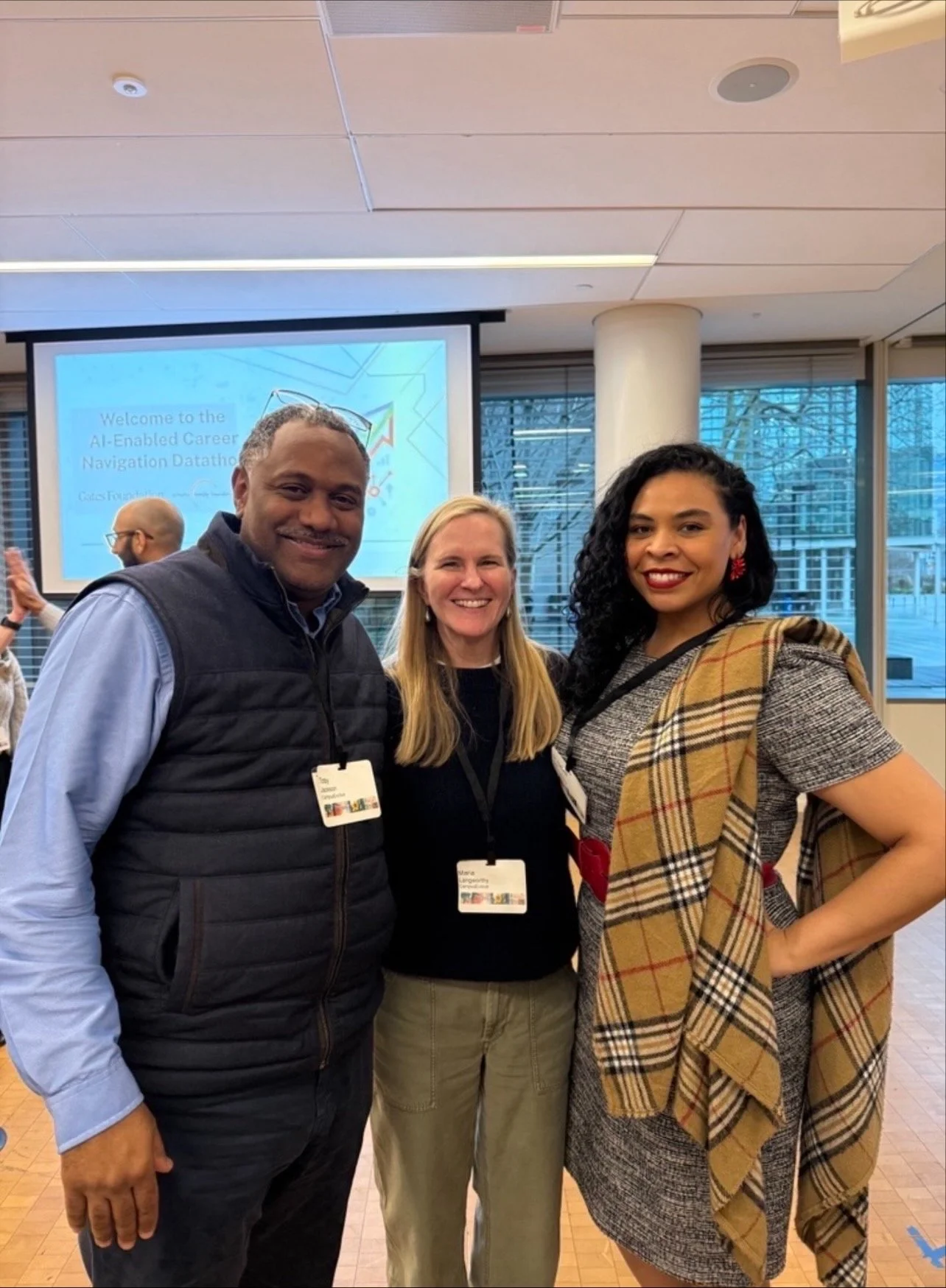


College Success Foundation staff and administrative staff from Davis High School who participated in CampusEvolve co-design sessions.
"GitLab Foundation was the first funder to back this specific vision: an AI tool built for an entire state's workforce system, not just one campus. That $250,000 let us prove the concept works, and that proof of concept helped unlock,” even more funding, said Maria Langworthy, founder and managing partner at CampusEvolve. “What started as one nonprofit, one state agency and a startup is now a statewide initiative with a path to 2 million learners and plans to expand to additional states by 2027."
From streamlining financial aid access to transforming hiring practices, these organizations have made strides in advancing accessibility.
Over the next two years, they will continue expanding their reach — unlocking millions in additional lifetime earnings for workers nationwide.
